
Doctor-written skin guide · Johor Bahru
An acne scar changes the skin’s structure or texture, creating a depression or raised area. Post-inflammatory pigmentation is a flat brown, grey or darker mark left after inflammation. Red marks are another vascular colour change. These features can coexist but usually need different treatment strategies.

Written by Dr Kenneth Lee
Medical Director, Dr Plus Aesthetic Clinic
MBBCh (Cardiff University) · GDipFP Dermatology (NUS) · LCP-certified medical practitioner
Introduction
Patients often use the word scar for every mark that remains after a breakout. That language is understandable, yet the distinction matters clinically. A flat mark may gradually fade or respond to pigment-focused care, while a depression reflects tissue remodelling and may require a scar procedure. Treating colour as if it were texture—or texture as if it were colour—can waste time and increase risk.
For patients in Johor Bahru, local relevance should come from practical care: Malaysia’s year-round ultraviolet exposure, heat and humidity can affect sunscreen habits, pigment control and recovery planning. Location does not change the biology of a condition, but it can change how a realistic plan is carried out.
Key takeaways
| Key point | What it means |
|---|---|
| Texture change | Depressed or raised tissue suggests true scarring. |
| Flat colour | Brown or grey marks commonly represent post-inflammatory hyperpigmentation. |
| Red marks | Post-inflammatory redness is vascular rather than excess melanin. |
| Mixed concerns | One area can contain pigment, redness and a textural scar. |
| Different treatments | Diagnosis determines whether care targets inflammation, pigment, vessels or structure. |
How colour and texture develop after acne
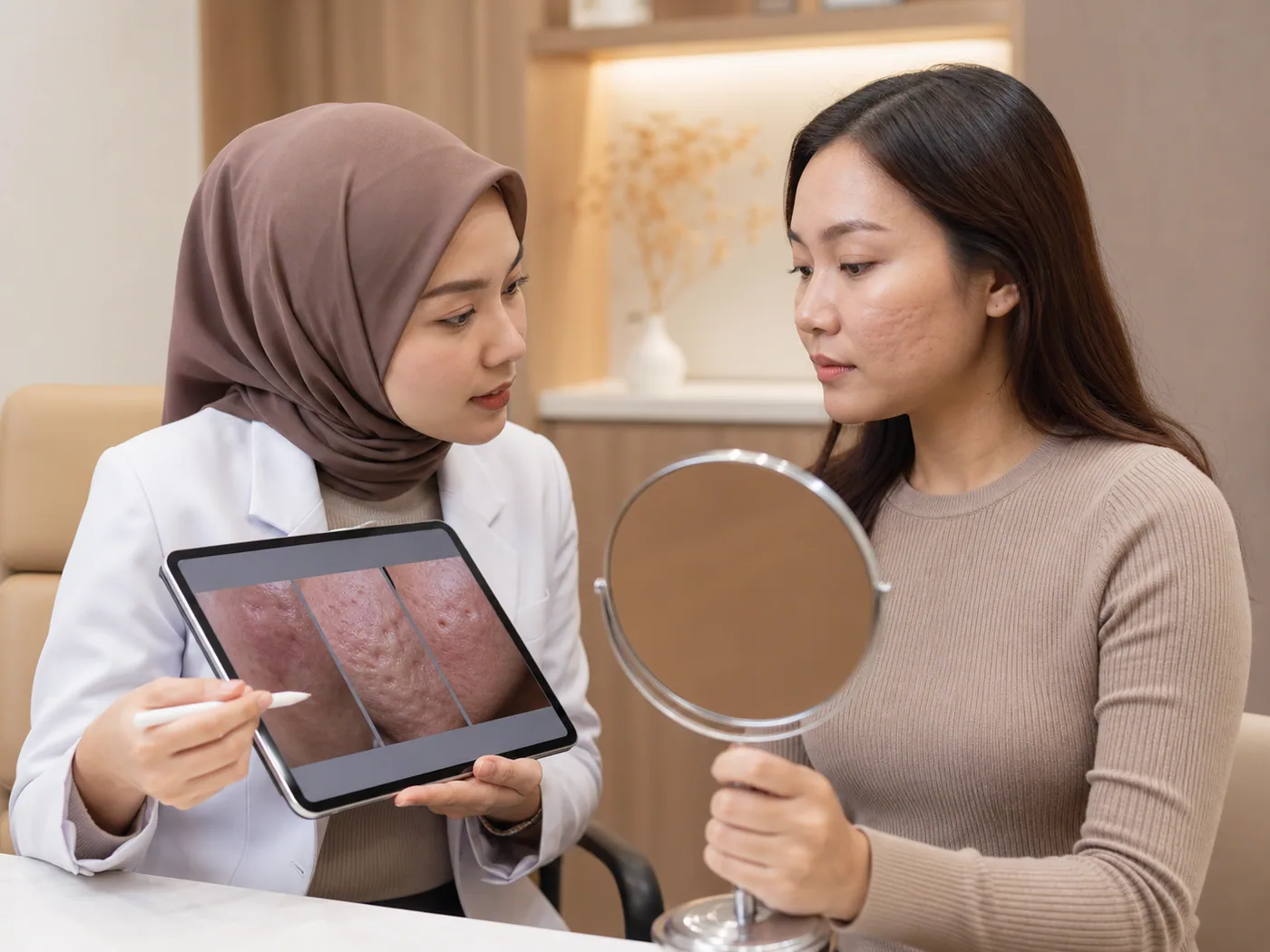
Inflammation can stimulate extra melanin, especially in darker skin tones, leaving a flat mark after the acne lesion resolves. Deeper inflammation may damage collagen and produce an atrophic depression; excessive collagen can produce a raised scar. Sun exposure can darken PIH, while picking can increase both pigment and scar risk.
- A mark that feels level with surrounding skin is more likely colour than atrophic scarring.
- A shadow that changes with directional light may indicate depressed texture.
- Brown, grey or black marks can represent pigment at different skin depths.
- Raised firm tissue extending beyond the original lesion may represent a keloid and needs a different pathway.
Evidence note: DermNet defines PIH as pigment following skin inflammation or injury and notes greater persistence in darker skin; acne-scar guidance distinguishes atrophic, hypertrophic and keloid structural changes. DermNet PIH · DermNet acne scarring · AAD scar overview · AAD scar guidance · NICE acne guideline
Why assessment comes before treatment
The doctor examines the feature in consistent lighting and may stretch or palpate the skin to reveal depressions. History helps distinguish a stable post-acne mark from melasma, sun damage, medication-related pigment or another lesion.
- Define the main concern in the patient’s own words and separate colour, texture, inflammation, volume and laxity rather than treating them as one problem.
- Review when the concern began, how it changes, what has already been tried and whether previous treatment caused irritation, pigment change or prolonged healing.
- Examine the skin in suitable lighting and consider skin tone, sensitivity, active disease, scar tendency and any features that require a different diagnosis or referral.
- Agree on the outcome that would be meaningful, the downtime that is manageable and the risks or trade-offs the patient does not want to accept.
Assessment is also where the doctor checks current medicines, previous procedures, pregnancy or breastfeeding where relevant, infection risk, wound-healing history, pigment tendency and the amount of recovery time a patient can realistically manage. These factors may change the treatment choice, intensity, sequence or whether treatment should be postponed.
How the treatment targets differ
A mixed concern can require more than one step, often beginning with acne control and sun protection.
Post-inflammatory pigmentation
Care may include time, strict sun protection and selected topical or procedural options. Irritation can worsen pigment, so aggressive treatment is not automatically better.
Post-inflammatory redness
Red or pink marks involve vascular change and may fade gradually. Pigment-lightening products do not address every red mark.
Atrophic scarring
Depressed texture may be assessed for subcision, resurfacing, RF microneedling or focal techniques depending on scar anatomy.
Raised scars
Hypertrophic or keloid scars need recurrence-aware treatment and should not be approached like depressed acne scars.
Benefits, limitations and realistic expectations
Flat marks often improve more than established depressions, but the timeline varies with pigment depth, skin tone, sun exposure and ongoing acne. Scar procedures can improve selected features but cannot guarantee complete removal. A photograph taken under different lighting can exaggerate either progress or failure.
Potential benefits
- Avoiding unnecessary scar procedures for a mainly pigmentary concern.
- Selecting treatments that address the actual target.
- More accurate progress tracking for colour and texture separately.
- Better counselling about time, recurrence and sun protection.
Important limitations
- Several concerns can overlap in the same area.
- PIH may be slow to fade and can recur after new inflammation.
- Procedures for texture can temporarily worsen colour.
- Complete removal of textural scarring cannot be guaranteed.
No article, photograph or device name can predict an individual result. Meaningful improvement may require a sequence of care, and the safest stopping point may arrive before every visible feature has disappeared.
Safety and who may not be suitable
Do not use high-strength home peels or unregulated bleaching products to chase rapid fading. Burns and dermatitis can deepen or prolong pigmentation, particularly in pigment-prone skin.
- Treatment may need to wait when there is active infection, significant irritation, a recent procedure or uncontrolled inflammation in the intended area.
- Pregnancy, breastfeeding, medicines, allergies, bleeding tendency and previous abnormal scarring should be discussed before a procedure or prescription is selected.
- Darker skin tones can be more prone to post-inflammatory pigment change after irritation, so preparation, treatment intensity and sun protection matter.
- A changing, bleeding or diagnostically uncertain lesion should be medically evaluated instead of being treated as an ordinary cosmetic concern.
Seek assessment for a pigmented spot that is new, changing, irregular, bleeding or unrelated to a known acne lesion. After treatment, seek help for blistering, severe pain, spreading redness, infection signs or unexpected loss of skin colour.
Preparation, recovery and aftercare
Control new acne, use non-comedogenic broad-spectrum sunscreen and avoid picking. Procedure aftercare should minimise inflammation, because every avoidable injury can create another cycle of pigment change.
- Follow the prescribed cleansing, moisturising and sun-protection instructions, keeping the routine simpler while the skin is sensitive.
- Avoid picking, scrubbing, unapproved acids or retinoids and unnecessary heat exposure until the treating clinician advises that they can be resumed.
- Use photographs taken in similar lighting to track gradual change rather than judging the skin repeatedly during temporary redness or swelling.
- Attend the planned review so response, side effects and the need for another stage can be assessed after the skin has had time to settle.
Follow the instructions given for your own treatment rather than copying another patient’s routine. Contact the treating clinic if recovery is more painful, prolonged or unusual than expected.
How this fits into a wider treatment plan
The acne-scar removal pillar addresses patients seeking improvement in established texture. This article protects that page from overpromising by clarifying that many so-called scars are flat marks with a different natural history.
This article supports the Acne Scar Removal Johor Bahru page. That service page remains the main destination for patients evaluating care in Johor Bahru, while this guide answers the narrower question described above.
Questions to take to your consultation
A good consultation should make the decision clearer even when the answer is not immediate treatment. Ask the doctor to identify the clinical target, explain the strength of evidence and show how your skin tone, medical history and previous response affect the recommendation. The discussion should cover what improvement would be meaningful, what is unlikely to change, what alternatives exist and what would make the doctor postpone or stop treatment.
- What diagnosis or anatomical feature is the treatment intended to address?
- What evidence supports this option for my specific concern and skin type?
- What are the most relevant side effects, complications and warning symptoms?
- How much social and medical downtime should I plan for at the proposed settings?
- How will progress be measured, and when is it reasonable to decide whether another stage is worthwhile?
- What lower-intervention alternative or referral option should I understand before consenting?
Write down the answers or ask for written aftercare. Decisions are safer when the patient understands both the potential benefit and the reasons a treatment may not be recommended.
Questions patients ask
Are all dark acne marks scars?
No. Many are flat post-inflammatory hyperpigmentation rather than permanent texture change.
Can pigment and scars occur together?
Yes. A depression can have surrounding brown or red colour.
How can I check texture at home?
Directional light may reveal shadows, but professional assessment is more reliable.
Will PIH fade by itself?
It often fades gradually, but deeper pigment, ongoing inflammation and sun exposure can prolong it.
Does sunscreen help acne marks?
Sun protection reduces ultraviolet-driven darkening and supports pigment management.
Can laser treat both colour and texture?
Different lasers and settings have different targets; one device should not be assumed to solve both.
Can chemical peels remove pitted scars?
Superficial peels may help selected colour or surface concerns but do not release deep tethering.
Why do marks last longer in darker skin?
Melanin responses to inflammation can be stronger and pigment may persist longer.
What are red acne marks?
They can represent post-inflammatory erythema, a vascular colour change rather than brown melanin pigment.
When should a dark spot be checked?
Promptly if it is new, changing, irregular, bleeding or not clearly linked to a previous breakout.
Conclusion
First decide whether the remaining feature is colour, texture or both. Flat pigment, redness, depressed scars and raised scars have different mechanisms and treatment pathways. Accurate classification creates safer expectations and prevents the phrase acne-scar removal from becoming an unrealistic promise.
Start with a doctor-led assessment
Bring your concern, treatment history, current skincare and questions. Dr Kenneth will explain the suitable options, limitations and next steps without promising a result.
Arrange a consultationReferences
- DermNet: Postinflammatory hyperpigmentation
- DermNet: Acne scarring
- American Academy of Dermatology: Acne scars overview
- American Academy of Dermatology: Acne scar consultation and treatment
- NICE guideline NG198: Acne vulgaris management
Medical information notice: This article provides general education and does not diagnose a condition or replace an in-person medical assessment. Treatment suitability, benefits, risks, alternatives and recovery vary between individuals.