
Doctor-written skin guide · Johor Bahru
Comedonal acne is dominated by blackheads and whiteheads, inflammatory acne produces red papules and pustules, and nodular acne forms deeper, painful lumps with a greater risk of scarring. Many patients have a mixture, so treatment is based on the full pattern and severity.

Written by Dr Kenneth Lee
Medical Director, Dr Plus Aesthetic Clinic
MBBCh (Cardiff University) · GDipFP Dermatology (NUS) · LCP-certified medical practitioner
Introduction
The word acne covers several lesion types rather than one uniform condition. Identifying the dominant pattern helps explain why one product may help clogged pores but be inadequate for deep, painful inflammation. It also helps decide when non-prescription care is reasonable and when prescription or specialist treatment should be considered.
For patients in Johor Bahru, local relevance should come from practical care: Malaysia’s year-round ultraviolet exposure, heat and humidity can affect sunscreen habits, pigment control and recovery planning. Location does not change the biology of a condition, but it can change how a realistic plan is carried out.
Key takeaways
| Key point | What it means |
|---|---|
| Comedonal acne | Blackheads and whiteheads form when follicles become blocked. |
| Inflammatory acne | Papules and pustules add visible redness, tenderness and pus. |
| Nodular acne | Deep painful lesions are more likely to scar and need medical treatment. |
| Mixed patterns | Several lesion types commonly occur at the same time. |
| Severity matters | Location, number, pain, scarring and psychosocial impact guide escalation. |

How acne lesion types differ
Acne develops through follicular plugging, sebum, microbial activity and inflammation. A closed comedone appears as a whitehead, while an open comedone appears dark because material at the opening is exposed to air—not because the pore is dirty. Papules are inflamed solid bumps, pustules contain visible fluid, and nodules or cyst-like lesions sit deeper in the skin.
- Blackheads and whiteheads without much redness suggest a mainly comedonal pattern.
- Red tender bumps and pus-filled lesions indicate greater inflammation.
- Deep painful lumps can persist longer and carry higher risk of permanent texture change.
- Acne can affect the face, chest, shoulders and back, and severity is not judged by the face alone.
Evidence note: AAD patient guidance describes blackheads, whiteheads, papules, pustules, nodules and cysts as lesions requiring different treatment approaches; NICE bases management on severity and patient factors. AAD acne types · NICE acne guideline · AAD scar overview · AAD scar guidance · DermNet acne scarring
Why assessment comes before treatment
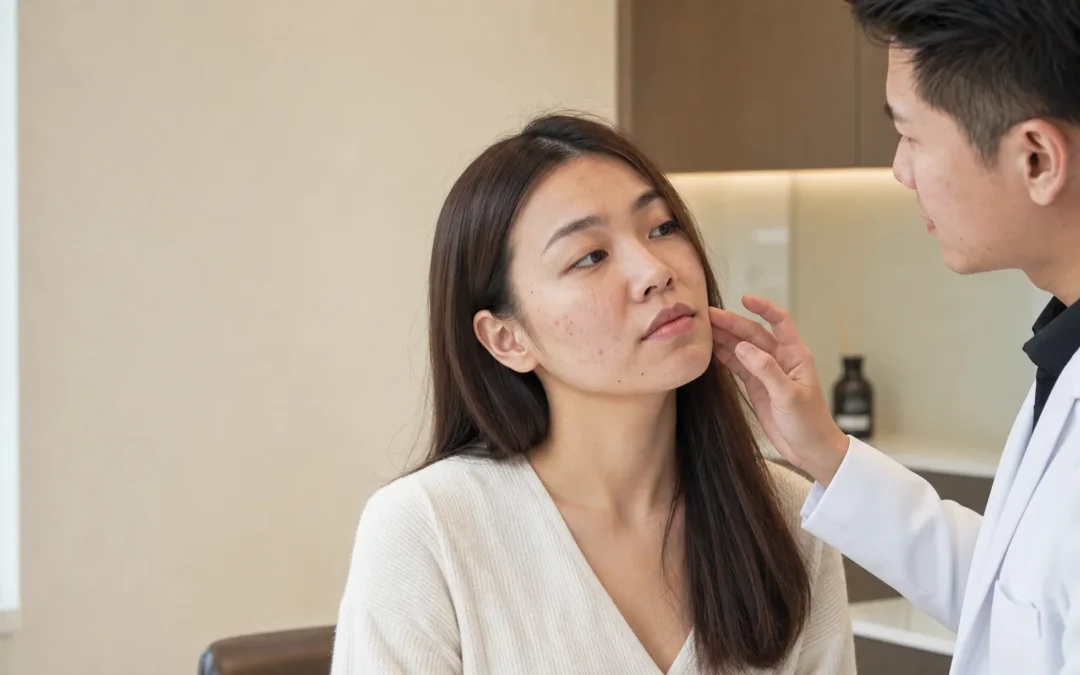
The doctor maps lesion type, distribution, duration and the presence of scars or pigment. The same number of lesions can have a different clinical impact depending on depth, pain, location and tendency to leave permanent marks.
- Define the main concern in the patient’s own words and separate colour, texture, inflammation, volume and laxity rather than treating them as one problem.
- Review when the concern began, how it changes, what has already been tried and whether previous treatment caused irritation, pigment change or prolonged healing.
- Examine the skin in suitable lighting and consider skin tone, sensitivity, active disease, scar tendency and any features that require a different diagnosis or referral.
- Agree on the outcome that would be meaningful, the downtime that is manageable and the risks or trade-offs the patient does not want to accept.
Assessment is also where the doctor checks current medicines, previous procedures, pregnancy or breastfeeding where relevant, infection risk, wound-healing history, pigment tendency and the amount of recovery time a patient can realistically manage. These factors may change the treatment choice, intensity, sequence or whether treatment should be postponed.
How lesion type influences treatment planning
Treatment choices should address more than one acne pathway and be given enough time to work. Individual medicines require assessment, particularly during pregnancy, with other medicines or when scarring is developing.
Comedonal pattern
Topical treatments that reduce follicular blockage may be considered. Gentle cleansing and non-comedogenic skincare support treatment but do not replace it.
Inflammatory pattern
Treatment may combine agents that address blocked follicles, inflammation and acne-associated bacteria. Antibiotic stewardship matters when topical or oral antibiotics are used.
Nodular or scarring pattern
Deep painful acne often needs earlier medical treatment because over-the-counter products may be insufficient and delay can allow further scarring.
Mixed and relapsing acne
A staged plan may control the active flare and then use maintenance treatment to reduce recurrence. Adherence and irritation management are part of effectiveness.
Benefits, limitations and realistic expectations
Improvement is measured over weeks and months, not days. Early dryness or irritation does not always mean an ingredient is unsuitable, but severe reactions need review. Treatment aims to reduce current lesions, prevent new lesions and lower the risk of scars and post-inflammatory colour change; it cannot guarantee that every future breakout will be prevented.
Potential benefits
- More appropriate treatment for the dominant acne pathway.
- Earlier escalation when painful or scarring lesions are present.
- Reduced temptation to squeeze lesions that need medical control.
- A maintenance plan after the initial flare improves.
Important limitations
- Online photographs cannot reliably grade depth or exclude acne-like conditions.
- No single product addresses every lesion type or cause.
- Hormonal and medication-related contributors may require a broader health review.
- Established scars need a separate plan after active acne is controlled.
No article, photograph or device name can predict an individual result. Meaningful improvement may require a sequence of care, and the safest stopping point may arrive before every visible feature has disappeared.
Safety and who may not be suitable
Deep, painful, rapidly worsening or scarring acne should not be managed by aggressive home extraction or repeated strong acids. Prescription options have important contraindications and monitoring requirements.
- Treatment may need to wait when there is active infection, significant irritation, a recent procedure or uncontrolled inflammation in the intended area.
- Pregnancy, breastfeeding, medicines, allergies, bleeding tendency and previous abnormal scarring should be discussed before a procedure or prescription is selected.
- Darker skin tones can be more prone to post-inflammatory pigment change after irritation, so preparation, treatment intensity and sun protection matter.
- A changing, bleeding or diagnostically uncertain lesion should be medically evaluated instead of being treated as an ordinary cosmetic concern.
Seek prompt medical review for severe painful nodules, rapidly spreading inflammation, fever, significant swelling, sudden acne after a new medicine or severe mood distress related to the condition. Do not squeeze deep lesions.
Preparation, recovery and aftercare
Use the treatment consistently as directed and support the barrier with gentle cleansing, moisturiser and non-comedogenic sun protection. Introduce only the advised changes so irritation or response can be interpreted.
- Follow the prescribed cleansing, moisturising and sun-protection instructions, keeping the routine simpler while the skin is sensitive.
- Avoid picking, scrubbing, unapproved acids or retinoids and unnecessary heat exposure until the treating clinician advises that they can be resumed.
- Use photographs taken in similar lighting to track gradual change rather than judging the skin repeatedly during temporary redness or swelling.
- Attend the planned review so response, side effects and the need for another stage can be assessed after the skin has had time to settle.
Follow the instructions given for your own treatment rather than copying another patient’s routine. Contact the treating clinic if recovery is more painful, prolonged or unusual than expected.

How this fits into a wider treatment plan
This explainer supports the acne-treatment pillar by helping patients describe their lesion pattern. The pillar remains the page for evaluating doctor-led acne care in Johor Bahru.
This article supports the Acne Treatment Johor Bahru page. That service page remains the main destination for patients evaluating care in Johor Bahru, while this guide answers the narrower question described above.
Questions to take to your consultation
A good consultation should make the decision clearer even when the answer is not immediate treatment. Ask the doctor to identify the clinical target, explain the strength of evidence and show how your skin tone, medical history and previous response affect the recommendation. The discussion should cover what improvement would be meaningful, what is unlikely to change, what alternatives exist and what would make the doctor postpone or stop treatment.
- What diagnosis or anatomical feature is the treatment intended to address?
- What evidence supports this option for my specific concern and skin type?
- What are the most relevant side effects, complications and warning symptoms?
- How much social and medical downtime should I plan for at the proposed settings?
- How will progress be measured, and when is it reasonable to decide whether another stage is worthwhile?
- What lower-intervention alternative or referral option should I understand before consenting?
Write down the answers or ask for written aftercare. Decisions are safer when the patient understands both the potential benefit and the reasons a treatment may not be recommended.
Questions patients ask
Are blackheads caused by dirt?
No. The dark colour comes from oxidation of material at an open follicle, not poor hygiene.
Is a whitehead the same as a pustule?
No. A whitehead is a closed comedone; a pustule is inflamed and contains visible fluid.
Why do nodules hurt?
They involve deeper inflammation within the skin and can remain tender for longer.
Can mild acne scar?
Yes, particularly when lesions are picked, though deep inflammatory acne carries greater risk.
Can I have several acne types at once?
Yes. Mixed comedonal and inflammatory patterns are common.
How long should treatment be tried?
Many treatments need several weeks before response can be judged; follow the review interval given.
Does oily skin always mean acne?
No. Oil can contribute, but acne also involves follicular plugging and inflammation.
Can skincare alone treat nodular acne?
Deep painful acne usually needs medical assessment and prescription-level management.
Are dark marks acne scars?
Flat post-inflammatory pigment is different from permanent textural scarring, though both can coexist.
When should I seek help?
Seek assessment for pain, scarring, persistent disease, treatment failure or significant impact on wellbeing.
Conclusion
Comedones, papules, pustules and nodules describe different parts of the acne spectrum. Naming the pattern is useful because deeper inflammation and scarring risk justify earlier medical care, while mixed acne often needs a combination plan and consistent maintenance.
Start with a doctor-led assessment
Bring your concern, treatment history, current skincare and questions. Dr Kenneth will explain the suitable options, limitations and next steps without promising a result.
Arrange a consultationReferences
- American Academy of Dermatology: How to treat different types of acne
- NICE guideline NG198: Acne vulgaris management
- American Academy of Dermatology: Acne scars overview
- American Academy of Dermatology: Acne scar consultation and treatment
- DermNet: Acne scarring
Medical information notice: This article provides general education and does not diagnose a condition or replace an in-person medical assessment. Treatment suitability, benefits, risks, alternatives and recovery vary between individuals.